House Preparation

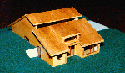
 Decide on a house design --For us, the house design started first. We had been reading about alternative housing technology for years, and playing with house ideas since we first
thought of building. However, the design was not finished until we knew exactly what sort of lot we were dealing with. Then we rented survey equipment and plotted out the slopes and
refined our plans. Then came the models. We tried out the plans to see just how the thing
would look.
Decide on a house design --For us, the house design started first. We had been reading about alternative housing technology for years, and playing with house ideas since we first
thought of building. However, the design was not finished until we knew exactly what sort of lot we were dealing with. Then we rented survey equipment and plotted out the slopes and
refined our plans. Then came the models. We tried out the plans to see just how the thing
would look.
We had hoped to build something earth contact but had to pull the house up out of the ground when the final plat placed us further over the north side of the hill than we had planned on.
As you can see from the model, the back (northwest) corner of the house still got a 40-inch deep berm.
 Find the land --We looked at lots in subdivisions and some country
property(one 46-acre Christmas tree farm). I wanted some space to perhaps have a horse, yet we didn't want to be a long commute from work. In the end, we opted for a
lot which was not in an established subdivision. What we wanted to try would not meet the requirements of the subdivisions' homeowner associations.
Besides, all the subdivision lots' higher prices really bought us was assured access to utilities. We would have to arrange the utilities another way.
Someone we knew was subdividing an old farm, and we were attracted to one of his lots. We worked with him through the platting process, and got assurances of water and electricity
service from the local utility company. Propane was a viable alternative to natural gas, so we would not have to run a gas line.
Find the land --We looked at lots in subdivisions and some country
property(one 46-acre Christmas tree farm). I wanted some space to perhaps have a horse, yet we didn't want to be a long commute from work. In the end, we opted for a
lot which was not in an established subdivision. What we wanted to try would not meet the requirements of the subdivisions' homeowner associations.
Besides, all the subdivision lots' higher prices really bought us was assured access to utilities. We would have to arrange the utilities another way.
Someone we knew was subdividing an old farm, and we were attracted to one of his lots. We worked with him through the platting process, and got assurances of water and electricity
service from the local utility company. Propane was a viable alternative to natural gas, so we would not have to run a gas line.
 Find money --Here is where we ran into problems. As soon as the land was purchased, we began to clear trees to get in. In Kansas, that was a no-no. With
any work done on the land, it meant that the lender could not have the first lien on the property. That, combined with the fact that we had never built a house before, closed the door
on any conventional money. We ended up borrowing from private sources.
Find money --Here is where we ran into problems. As soon as the land was purchased, we began to clear trees to get in. In Kansas, that was a no-no. With
any work done on the land, it meant that the lender could not have the first lien on the property. That, combined with the fact that we had never built a house before, closed the door
on any conventional money. We ended up borrowing from private sources.
 Get permission to do the work. Since we were building the house ourselves, we had to work closely with the building inspectors. In Kansas City, KS, there are
things you can do yourself if you can prove to the chief building inspector that you know what you are doing. This involved taking tests on the building codes and electrical and
plumbing codes.
Get permission to do the work. Since we were building the house ourselves, we had to work closely with the building inspectors. In Kansas City, KS, there are
things you can do yourself if you can prove to the chief building inspector that you know what you are doing. This involved taking tests on the building codes and electrical and
plumbing codes.
 Make the details work --It took quite a while to study the building codes and incorporate the requirements into our house drawings. Some details such
as our trusses required engineering which required extra study(thank goodness for libraries) and help from people we knew who had the knowledge needed. The large truss which spanned the
garage was one which took extra attention. Even though the codes were the standard reading material during this period, we were never done consulting those invaluable books until the
final inspection was passed.
Make the details work --It took quite a while to study the building codes and incorporate the requirements into our house drawings. Some details such
as our trusses required engineering which required extra study(thank goodness for libraries) and help from people we knew who had the knowledge needed. The large truss which spanned the
garage was one which took extra attention. Even though the codes were the standard reading material during this period, we were never done consulting those invaluable books until the
final inspection was passed.
 Get the house plan approved As soon as our drawings were final, we had to get them approved by the chief building inspector. Then we had a set of paperwork
and fees and we were on the way.
Get the house plan approved As soon as our drawings were final, we had to get them approved by the chief building inspector. Then we had a set of paperwork
and fees and we were on the way.
 Make arrangements with your subcontractors This actually begins before step 6 is completed. If you are working with a good company, they can have a pretty
full calendar. We had a little problem with the excavation work, because we were trying to push the end of the season. We didn't actually need to buy many services, because
our county let homeowners do so much of the work themselves. They did require professionals install the HVAC and septic tank, and we wanted the excavation, concrete, and waterproofing done.
Make arrangements with your subcontractors This actually begins before step 6 is completed. If you are working with a good company, they can have a pretty
full calendar. We had a little problem with the excavation work, because we were trying to push the end of the season. We didn't actually need to buy many services, because
our county let homeowners do so much of the work themselves. They did require professionals install the HVAC and septic tank, and we wanted the excavation, concrete, and waterproofing done.